My interest in this area originated in 2024, when at Hack the North, my teammates and I created EcoVision, a computer vision ML model that uses a phone's camera feed to determine whether an item is recyclable. This application showed me the potential of technology changing lifestyles and facilitating environmental initiatives.
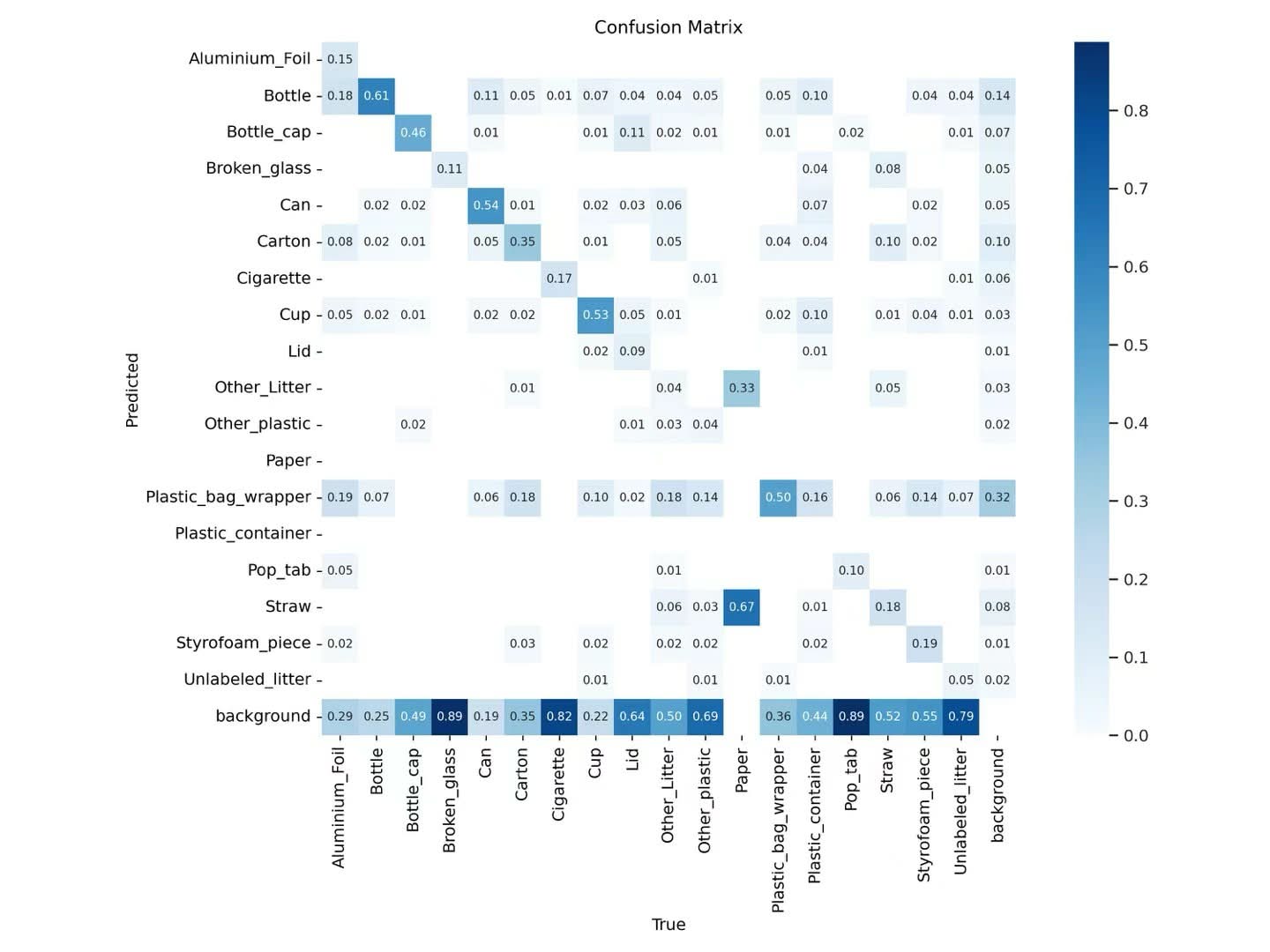
It is built in two halves. A SwiftUI iOS app takes frames from the camera, and a Flask server behind it runs a YOLOv5 detector fine-tuned on TACO, the litter dataset, at a 0.33 confidence threshold with non-maximum suppression at 0.45 IoU.
The part that makes it useful rather than merely accurate is the mapping. Detection alone returns a litter class, which is not the question a person standing over a bin is asking. Each of the eighteen classes is therefore mapped to the only answer that matters — a can, a bottle cap, a carton, a straw resolve to recyclable or garbage — so the app returns a decision instead of a taxonomy.
The answers are less obvious than they look: a carton and a straw are garbage while a cup and a plastic container are recyclable, which is exactly the sort of thing people get wrong at the bin. Weights were kept at eight, sixteen and thirty-two epochs so the trade-off between training time and detection quality stayed visible rather than being collapsed into a single checkpoint.
Screens